
Wang Yi's Seoul Visit Leaves South Korea Diplomatically Squeezed
Chinese Foreign Minister Wang Yi wrapped up a two-day trip to Seoul without endorsing South Korea's push for multiparty peace talks with North Korea, complicating Seoul's efforts to balance ties with Beijing and Washington.
Chinese Foreign Minister Wang Yi wrapped up a two-day trip to Seoul without endorsing South Korea's push for multiparty peace talks with North Korea, complicating Seoul's efforts to balance ties with Beijing and Washington.
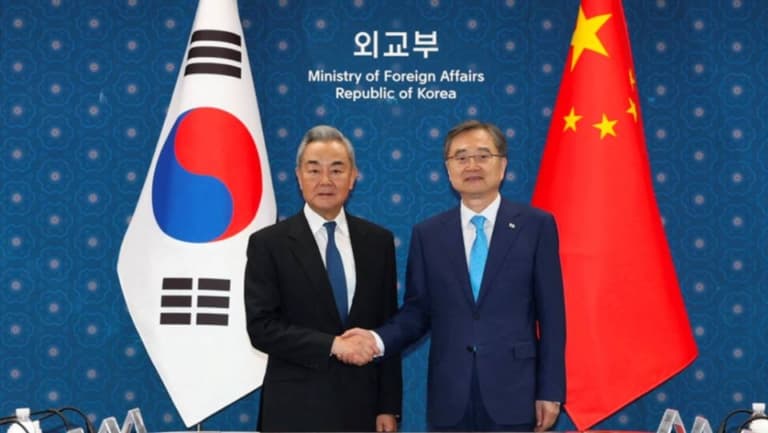
Chinese Foreign Minister Wang Yi concluded a two-day visit to South Korea on Friday, his first solo trip to the country in five years, without backing Seoul's proposal for multiparty peace talks involving North Korea. The outcome underscored the limits of the warm rhetoric both governments used to describe the state of bilateral relations.
The visit came just weeks after President Xi Jinping traveled to Pyongyang in June, his first trip there in seven years, and overlapped with a separate shift in Washington's posture. US President Donald Trump has moved to scale back joint military exercises with South Korea while calling for renewed dialogue with North Korean leader Kim Jong-un. Pyongyang answered with more than ten short-range ballistic missile launches on Thursday, prompting South Korea's presidential office to convene an emergency security meeting just as Wang was arriving.
During the trip, Chinese and South Korean officials declared that relations had "fully recovered" after years of strain, pointing to renewed leader-level exchanges and expanding cooperation in trade, technology and people-to-people ties. Yet behind the celebratory tone, Wang delivered a pointed message to President Lee Jae Myung and other senior officials in Seoul.
According to China's foreign ministry, Wang urged South Korea to pursue what he called "genuine strategic autonomy" and avoid "bloc confrontation or taking sides," while developing relations with Beijing and Washington in what he described as a mutually compatible manner. The language, while diplomatically framed, was widely read as a caution against Seoul deepening its security alignment with the United States.
Analysts say the visit effectively left Seoul in a tighter spot rather than easing its diplomatic balancing act. Despite the friendly optics, Beijing stopped short of endorsing South Korea's proposed peace framework for the Korean peninsula, denying Lee's government a diplomatic win it had hoped to showcase. That gap, paired with Pyongyang's missile tests and Washington's recalibration of military drills, has left Seoul navigating pressure from all three major powers simultaneously.
The episode illustrates a recurring dilemma for South Korea: warmer atmospherics with Beijing have not translated into substantive backing for Seoul's own initiatives, even as Washington's shifting approach to the alliance adds further uncertainty to the region's security calculus.
Where it matters
Related coverage

China's Wang Yi Courts Seoul With 'Strategic Autonomy' Pitch Amid Strains in US Alliance
As Trump Courts Kim, North Korea Raises Its Price While Seoul Fears Being Sidelined
North Korea is responding to President Trump's renewed outreach to Kim Jong Un by hardening its demands rather than shutting the door, leaving South Korea anxious it could be left out of talks that directly affect its own security.
China and South Korea Prepare for Leaders' Summit on Sidelines of APEC Shenzhen
China's Wang Yi Visits Seoul as Trump Signals Push to Revive North Korea Talks
Chinese Foreign Minister Wang Yi arrived in Seoul for talks with his South Korean counterpart Cho Hyun, days after Seoul and Washington scaled back joint military exercises, as U.S. President Donald Trump voices renewed interest in engaging North Korean leader Kim Jong Un.