As Trump Courts Kim, North Korea Raises Its Price While Seoul Fears Being Sidelined
North Korea is responding to President Trump's renewed outreach to Kim Jong Un by hardening its demands rather than shutting the door, leaving South Korea anxious it could be left out of talks that directly affect its own security.
North Korea is responding to President Trump's renewed outreach to Kim Jong Un by hardening its demands rather than shutting the door, leaving South Korea anxious it could be left out of talks that directly affect its own security.
North Korea appears to be testing how far it can push President Trump before agreeing to sit down with Kim Jong Un again, responding to Washington's latest overture not with acceptance but with tougher demands and a show of force. The tug-of-war is unsettling officials in Seoul, who worry that a renewed Trump-Kim dialogue could once again unfold largely without them, even though any deal would shape South Korea's own security for years to come.
The friction became visible this week after Trump ordered the Pentagon to shorten the annual joint military exercises with South Korea, which wrapped up six days ahead of schedule on Friday. Pyongyang was unimpressed. Hours after Trump said he would meet Kim later this year, North Korea fired roughly a dozen short-range ballistic missiles from around Pyongyang toward the sea, according to South Korea's Joint Chiefs of Staff. In a statement carried by state media, Kim Yo Jong, the North Korean leader's influential sister, dismissed the shortened drills as "unworthy of comment" and insisted they remained provocative regardless of their length.
Trump had explained his decision in a social media post on Monday, arguing the drills were costly and sent an unnecessarily hostile signal to Pyongyang. He later said he had reached out to Kim about a possible meeting and received a positive response. Kim Yo Jong pushed back on that claim, saying she was "not aware of it at all," while still noting that ties between the two leaders remain "excellent." Kangwon National University political scientist Kuyoun Chung reads that mixed messaging as an effort to raise the price of reengagement rather than an outright rejection of a summit.
Underlying the standoff is Pyongyang's now-familiar precondition: formal recognition as a nuclear-armed state before any new negotiations begin, a demand Washington has resisted because it would undercut decades of policy aimed at denuclearization and violate U.N. Security Council resolutions. The dynamic is a far cry from 2018 and 2019, when Seoul helped broker three Trump-Kim summits, only for the process to collapse after the failed Hanoi meeting, following which Kim reportedly dismissed Trump as an "idiot." Since then North Korea has formally abandoned the goal of reunification with the South, signed a mutual defense pact with Russia, and rebuilt ties with China, all of which have diminished Seoul's leverage as a go-between.
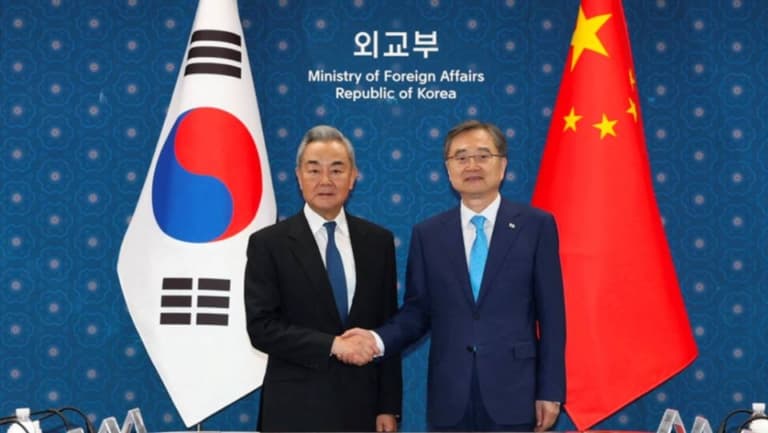
South Korean officials say they still hope Trump's outreach leads to renewed diplomacy, but this week's whiplash has deepened anxiety that Seoul could be cut out of decisions with major consequences for its own defense. Analysts warn Trump could offer to pull back U.S. troops or ease sanctions to secure a deal, without requiring the North to give up its nuclear arsenal. "The United States would simply reap the diplomatic benefits of the summit," Chung said, "while South Korea bears all the security consequences." In an apparent hedge, Seoul this week asked visiting Chinese Foreign Minister Wang Yi for help stabilizing the peninsula; Wang pledged Beijing would keep promoting peace but suggested Washington and Pyongyang should sort out a summit on their own, adding that the U.S. should abandon what he called its hostile policies.
The episode has also exposed strain in the U.S.-South Korea alliance itself. Foreign Minister Cho Hyun told lawmakers Wednesday he would work to keep the alliance from weakening, while acknowledging Seoul was caught off guard by Trump's order. Trump, for his part, has linked the drill decision to unrelated grievances, including South Korea's refusal to join U.S. operations against Iran and the pace of Seoul's pledged $350 billion investment in the United States in exchange for lower tariffs. Yu Jihoon of the Korea Institute for Defense Analyses said Washington and Seoul largely share the same goals, but warned that Trump's transactional style risks a slow but real decline in trust. A recent JoongAng Daily-East Asia Institute poll suggests that erosion is already underway: only 45.4% of South Koreans now view the U.S. as a trustworthy partner, versus 46% who do not, with most critics citing what they see as coercive American pressure on trade, investment and defense.
Where it matters
Related coverage
China and South Korea Prepare for Leaders' Summit on Sidelines of APEC Shenzhen
China's Wang Yi Visits Seoul as Trump Signals Push to Revive North Korea Talks
Chinese Foreign Minister Wang Yi arrived in Seoul for talks with his South Korean counterpart Cho Hyun, days after Seoul and Washington scaled back joint military exercises, as U.S. President Donald Trump voices renewed interest in engaging North Korean leader Kim Jong Un.
China Tests South Korea Opening as Trump Unsettles Alliance
Beijing is dispatching top diplomat Wang Yi to Seoul, seeking to exploit strains in the US-South Korea alliance after Washington scaled back joint military exercises, Bloomberg reports.
