Samsung SDI to Start Making LFP Batteries in Indiana for US Energy Storage Market
Samsung SDI will begin producing prismatic lithium-iron phosphate batteries for energy storage systems at its Indiana plant, converting existing EV lines to serve the fast-growing US grid storage market.
Samsung SDI will begin producing prismatic lithium-iron phosphate batteries for energy storage systems at its Indiana plant, converting existing EV lines to serve the fast-growing US grid storage market.
Samsung SDI has announced plans to begin manufacturing lithium-iron phosphate (LFP) batteries for energy storage systems at its facility in Kokomo, Indiana, marking a significant step in the South Korean battery maker's push to localize production for American customers. The company will convert a portion of its existing electric vehicle battery lines at the site to produce the new LFP cells.
The Indiana factory operates as StarPlus Energy, a joint venture between Samsung SDI and automaker Stellantis that was originally built with an estimated annual capacity of 34 gigawatt-hours. Repurposing part of that capacity for stationary storage batteries allows Samsung SDI to respond quickly to surging demand for grid-scale and commercial energy storage in the United States without building an entirely new plant.
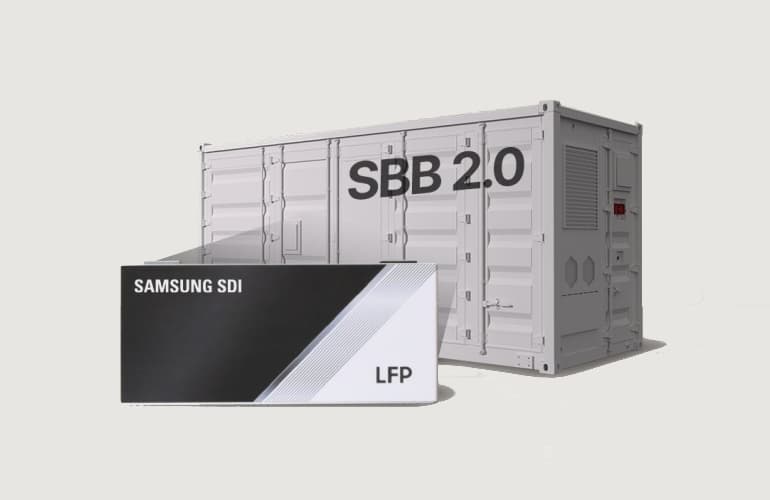
The new cells will be prismatic LFP batteries packaged into Samsung SDI's Samsung Battery Box (SBB) 2.0, a containerized energy storage unit built into a 20-foot shipping container. The company first introduced the SBB format in 2023 using nickel-based NCA chemistry, and the addition of LFP technology broadens its product lineup to compete more directly with the lower-cost, safety-focused batteries that have become the industry standard for large storage installations.
Samsung SDI says its prismatic LFP cells offer added durability thanks to an aluminum casing and built-in safety features such as vents and fuses, making them more resistant to external impacts than many competing cell formats. The cells also incorporate the company's proprietary No Thermal Propagation technology, which uses insulating materials between cells and a predictive temperature-monitoring system to keep heat from spreading between cells in the event of a malfunction.
With this move, Samsung SDI positions itself as the only non-Chinese manufacturer producing prismatic LFP batteries within the United States, a notable distinction in a market where Chinese firms have long dominated LFP cell production. Manufacturing domestically is also expected to help Samsung SDI's ESS customers qualify for local-content incentives tied to US clean energy policy, while insulating the supply chain from geopolitical and tariff risks.
The expansion reflects Samsung SDI's broader strategy of diversifying beyond electric vehicle batteries as EV demand growth has slowed in parts of the US market, while energy storage remains one of the fastest-growing segments of the American power sector. Analysts expect the shift toward stationary storage production to provide a more stable revenue stream for the company as utilities and developers continue to build out battery storage capacity alongside solar and wind projects nationwide.
Related companies
Where it matters
Related coverage
Hanwha Ocean's 'Floating Refinery' Sets Sights on South American Deep-Sea Oilfields
Samsung SDI clinches US battery deal worth over $1.4 billion
Samsung SDI, KGM Join Forces on Next-Generation EV Battery Packs