Samsung SDI, KGM Join Forces on Next-Generation EV Battery Packs
Samsung SDI and KG Mobility have signed a memorandum of understanding to co-develop next-generation cylindrical EV battery pack technology, their first strategic tie-up on advanced batteries. The deal centers on packs built around Samsung SDI's 46-series cylindrical cells and is expected to feature in KGM's future SUV lineup.
Samsung SDI and KG Mobility have signed a memorandum of understanding to co-develop next-generation cylindrical EV battery pack technology, their first strategic tie-up on advanced batteries. The deal centers on packs built around Samsung SDI's 46-series cylindrical cells and is expected to feature in KGM's future SUV lineup.
Samsung SDI and KG Mobility have agreed to jointly develop battery pack systems built around Samsung SDI's 46-millimeter cylindrical cells, the companies announced this week, in what both sides describe as their first strategic partnership focused on next-generation battery technology.
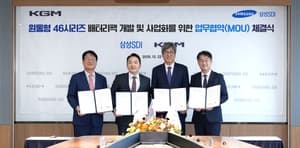
The memorandum of understanding, signed in Seoul, was represented by Choi Ick-kyu, executive vice president and head of Samsung SDI's small battery division, and Kwak Jeong-hyun, chief strategy officer at KGM. Beyond the pack development itself, the two firms plan to share intelligence on global battery market trends and pursue broader joint research over the medium to long term. The resulting packs are expected to be fitted into KGM's upcoming electric models, including large SUVs.
For Samsung SDI, the tie-up offers a domestic proving ground for its 46-series cylindrical cells, a product line the company began mass-producing in March for micromobility uses. The cells promise higher energy density than smaller cylindrical formats, translating into longer driving range and quicker charging. Samsung SDI has been pursuing a dual-track battery strategy, keeping prismatic cells as its mainstay business while ramping up cylindrical output as a future growth driver, a shift accelerated by softer EV demand and Washington's retreat from aggressive electrification policies. BMW remains the company's flagship global buyer of the format, and adding a Korean automaker as a customer would broaden its revenue mix.
For KGM, the agreement signals a deliberate pivot away from its heavy reliance on Chinese battery suppliers such as BYD, which the company had favored for cost reasons in vehicles like the Torres EVX. According to a KGM representative, the automaker's electric lineup has so far leaned on lithium iron phosphate cells, but it now intends to bring in nickel-cobalt-manganese chemistry to extend range and performance in premium models. Squeezed by Hyundai Motor Group's dominant position in Korea's EV market, KGM has carved out a niche strategy, undercutting comparable Hyundai and Kia models on price and introducing the Musso EV pickup, a segment neither rival currently serves.
Until now, KGM's cooperation with domestic battery makers had been largely confined to buses and commercial vehicles, making this MOU a notable expansion into passenger EVs. Samsung SDI describes the 46-series cells as combining high-capacity nickel-cobalt-aluminum cathodes with a proprietary silicon-carbon nanocomposite anode designed to limit swelling and prolong cell life, alongside a tabless architecture that shortens current paths to cut resistance and improve both charging speed and thermal safety.
Industry observers view the partnership as mutually reinforcing: Samsung SDI gains a new domestic outlet to commercialize its advanced cylindrical technology, while KGM gains a path to diversify its supply chain and strengthen the technical credentials of its next wave of electric SUVs and pickups.
Related companies
Where it matters
Related coverage

Hyundai Motor to Supply Official Vehicles for First Korea-Central Asia Summit in 2026
Hyundai Mobis Posts Mixed Q2 Results as Governance Overhaul Fuels Stock Speculation
Hyundai Mobis beat profit expectations in the second quarter of 2026 thanks to strong after-sales earnings, but analysts remain split on the outlook as investors weigh a possible group governance restructuring.
Samsung SDI to Start Making LFP Batteries in Indiana for US Energy Storage Market