Samsung Biologics' 3 Trillion Won Rights Offering Faces Test at Financial Watchdog
Samsung Biologics has launched a roughly 3 trillion won rights offering to fund its acquisition of Swiss CDMO firm PolyPeptide Group and expand production capacity, but the deal now must clear an increasingly strict review by Korea's Financial Supervisory Service.
Samsung Biologics has launched a roughly 3 trillion won rights offering to fund its acquisition of Swiss CDMO firm PolyPeptide Group and expand production capacity, but the deal now must clear an increasingly strict review by Korea's Financial Supervisory Service.
Samsung Biologics has moved to raise about 3 trillion won through a rights offering, and the market's attention has shifted to whether the plan can pass scrutiny from South Korea's Financial Supervisory Service (FSS), which has grown tougher on large corporate capital raisings this year.
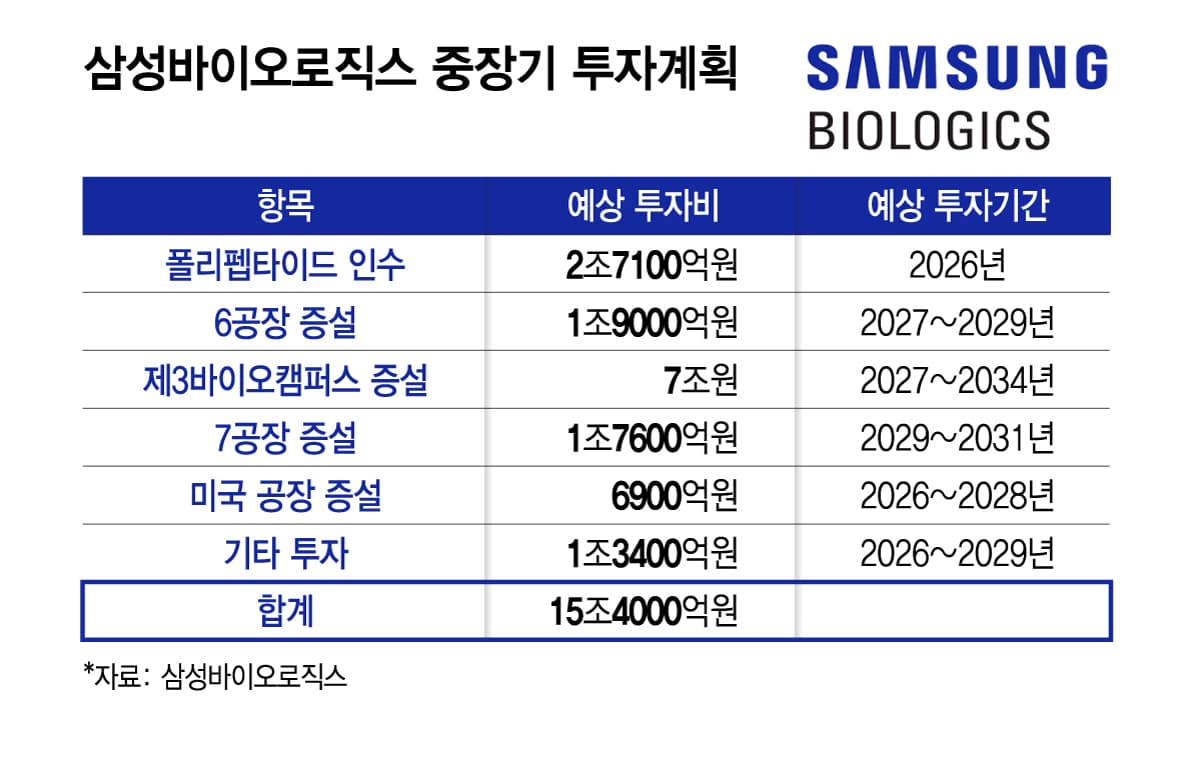
The biopharmaceutical giant said it will use roughly 90% of the proceeds, about 2.71 trillion won, to acquire 100% of PolyPeptide Group AG, a Swiss contract development and manufacturing (CDMO) specialist in peptide therapeutics. The remaining 295 billion won will go toward expanding the sixth plant at its second bio campus. The offering will be structured as a shareholder-priority issue followed by a general public sale of any unclaimed shares, with new shares equal to roughly 4.9% of outstanding stock, a relatively small dilution compared with other recent trillion-won deals.
That contrast matters because the FSS has repeatedly forced companies such as Samsung SDI, Hanwha Aerospace and Hanwha Solutions to revise their registration statements for large rights offerings this year, delaying schedules and pressuring share prices. Hanwha Solutions eventually had to shrink its offering from 2.4 trillion won to 1.7 trillion won after regulators pushed back, partly because more than half of the funds were earmarked for debt repayment rather than growth.
Samsung Biologics appears to be trying to avoid that fate by spelling out its rationale in detail. The company stated explicitly that none of the new funds will be used to repay debt, framing the entire amount as growth capital for the acquisition and facility expansion. Its securities registration statement also laid out specific risk factors, including potential US pharmaceutical tariffs under the Trump administration, the risk that global drugmakers increase in-house production and cut outsourcing, possible delays or failure of the PolyPeptide deal, and integration risks after the acquisition closes.
An FSS official said it is a misconception that any trillion-won-scale rights offering automatically triggers correction demands, adding that regulators focus on "how clear the purpose of the funds is" and how persuasive the case would be to shareholders asked to put up more money. The regulator plans to differentiate its review going forward, publicly flagging companies whose disclosures remain inadequate even after correction requests, while moving faster on filings from firms that have been transparent about risks, like Samsung Biologics.
Investors appear to be taking the more favorable view. Credit rating agencies have described the fundraising positively, and shares in Samsung Biologics gained after the company unveiled the acquisition and offering together, easing some of the uncertainty that had built up in the days before the announcement.
Related companies
Where it matters
Related coverage
Samsung Biologics Defends 3.9 Trillion Won Rights Offering as Key to Long-Term Growth Plan

Woori Financial Chairman Buys 5,000 More Shares in Push for Higher Corporate Value

Hyundai Glovis Shares Climb as Investors Cheer Record Quarterly Revenue