How Diplomacy Changed Korea's Fate — and Its Future
From Syngman Rhee's postwar survival diplomacy to Lee Jae Myung's pursuit of an 'Irreplaceable Korea,' 81 years of foreign policy show Seoul converting vulnerability into leverage — with economic security now at the center of that effort.
From Syngman Rhee's postwar survival diplomacy to Lee Jae Myung's pursuit of an 'Irreplaceable Korea,' 81 years of foreign policy show Seoul converting vulnerability into leverage — with economic security now at the center of that effort.
For most of its 81-year history as a modern state, South Korea's diplomacy was a story of managing dependence rather than exercising choice. From the 1953 armistice that ended the Korean War, President Syngman Rhee understood that Seoul could not dictate terms to its powerful allies, but could still make abandonment costly, a calculation that helped secure the Mutual Defense Treaty with Washington. His successors built on that foundation: Park Chung-hee turned alignment with the United States and Japan into industrial development, Roh Tae-woo broke through Cold War barriers by normalizing ties with Moscow and Beijing, and by the 1990s Seoul had joined the United Nations, the World Trade Organization and the OECD, only to be humbled by the 1997 Asian financial crisis.
The years that followed saw Korea turn recovery into renewed ambition. Kim Dae-jung rebuilt credibility through what amounted to economic diplomacy, courting all four major powers while repaying IMF loans ahead of schedule. Roh Moo-hyun pushed for a "Northeast Asian balancer" role that stretched Korea's actual leverage but signaled a growing appetite for strategic autonomy. Lee Myung-bak went further still, casting Korea's own journey from aid recipient to G20 host as a model other developing nations could look to.
That steady widening of Korea's diplomatic room began colliding with harder geopolitical realities in the 2010s. Park Geun-hye's attempt to balance a US security alliance with deepening Chinese economic ties collided with Beijing's retaliation over the deployment of the THAAD missile defense system, exposing how quickly economic interdependence could be weaponized. Moon Jae-in tried to preserve flexibility through peace diplomacy with Pyongyang and a New Southern Policy aimed at diversifying partners, but Japan's 2019 restrictions on semiconductor materials exports and pandemic-era supply chain disruptions revealed just how exposed Korea's trade-dependent economy had become in critical technology sectors.
Those shocks pushed economic security to the center of Korean foreign policy. As Washington and Beijing extended their rivalry into semiconductors, batteries and critical minerals, President Yoon Suk Yeol argued that Korea's answer lay in strategic clarity rather than ambiguity. Anchoring the country more closely to the United States and other value-aligned partners, Yoon said in 2023 that a robust alliance and cooperation with like-minded nations formed the foundation for an economy so reliant on international trade. That approach produced the Washington Declaration, the Camp David summit and expanded three-way cooperation on chips and critical minerals with the US and Japan, marking a shift from managing relationships to managing strategic dependencies.
President Lee Jae Myung inherited that framework amid renewed tariff pressure from Washington and continued Chinese leverage over critical minerals, alongside global shocks from the wars in Ukraine and the Middle East. His response, which he calls pragmatic diplomacy centered on national interest, runs on two tracks: diversifying partners across Southeast Asia, Central Asia and Latin America to reduce overdependence on any single market, while deepening cooperation with the US and NATO on defense industry and advanced technology where Korean interests are most exposed. Proposals for expanded defense-industry cooperation with NATO and an AI supply chain declaration unveiled in San Francisco reflect an effort to convert Korea's industrial and technological strengths into diplomatic leverage.
Eighty-one years after a Korean delegation traveled to Paris to plead for UN recognition without a seat or a vote, Seoul now chairs UN Security Council sessions and positions itself as what Lee calls an "Irreplaceable Republic of Korea." The through-line connecting Rhee's search for survival to Lee's pursuit of indispensability is a steady conversion of vulnerability into leverage, with economic security now standing as the clearest test of how well that transformation holds up against an increasingly divided world.
Where it matters
Related coverage

North Korea Fires Ballistic Missile as Seoul, Washington Prepare Joint Drills
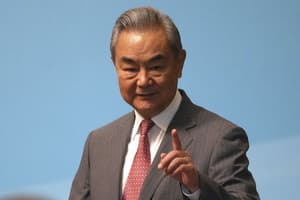
China's Top Diplomat Wang Yi Likely to Visit South Korea Next Week
South Korea's Ministers Clash Publicly Over North Korea Policy as Lee Pushes Engagement
South Korea's Foreign and Unification ministers publicly disagreed this week over how to approach North Korea, exposing rifts in President Lee Jae Myung's push to revive stalled inter-Korean contact.